
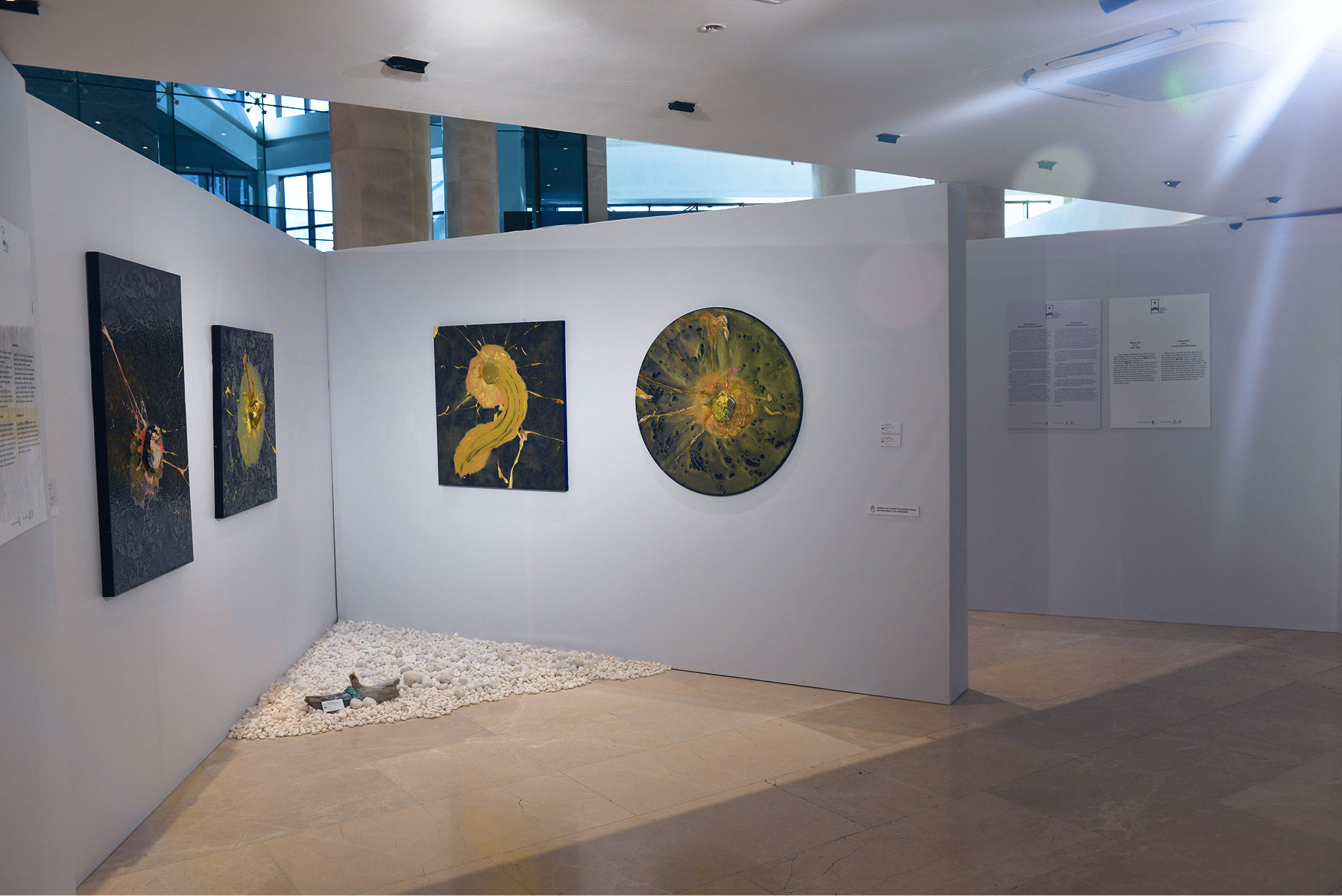
Exhibition Dates
September 20, 2025 ~ October 4, 2025
Venue
Chinggis Khaan National Museum, 1st Floor Exhibition Hall (Ulaanbaatar)
Organizer
Kveritas Co., Ltd.
Curator
D. Tomlsuff
Supported by
Embassy of Japan in Mongolia, Genghis Khan National Museum
The Chinggis Khaan National Museum is Mongolia’s foremost national cultural institution. In 2024, it was selected by the National Geographic Society as one of the “20 museums in the world you must visit,” further strengthening its international standing and cultural significance.
In this historic setting, Toru Kuranuki presented his work and articulated the worldview of Kyōzon. The exhibition resonates with the spirit once embodied by the Mongol Empire in the 13th century—an intelligence of living in harmony with nature—and seeks to reawaken that wisdom for the 21st-century era of the Anthropocene. It is also an attempt to propose, to the world, a new path forward—one that moves beyond division and adversity.
Kuranuki’s journey to exhibit at the Chinggis Khaan National Museum began on June 11, 2025. His first destination was the home of Odi, a Mongolian shaman known as the “Black Dragonfly.”
For Kuranuki, stone is not merely a material; it is a presence—something with its own intention, a partner in the act of painting. Yet in Mongolia, too, stone is regarded as sacred, bound to ancestors and the heavens, and not something to be touched lightly. Upon arrival, he was warned accordingly.
“Is it truly permitted to use the stones of this land in my work?”
The ritual lasted more than three hours. As smoke from burned herbs rose toward the sky, only wind and the beat of a drum filled the air.
Then came the answer from the heavens: Yes.
“Do not forget gratitude. Offer milk and liquor to the earth before you take a stone into your hands.”
In that moment, a journey that began in a foreign land transformed into a story of permission and resonance.
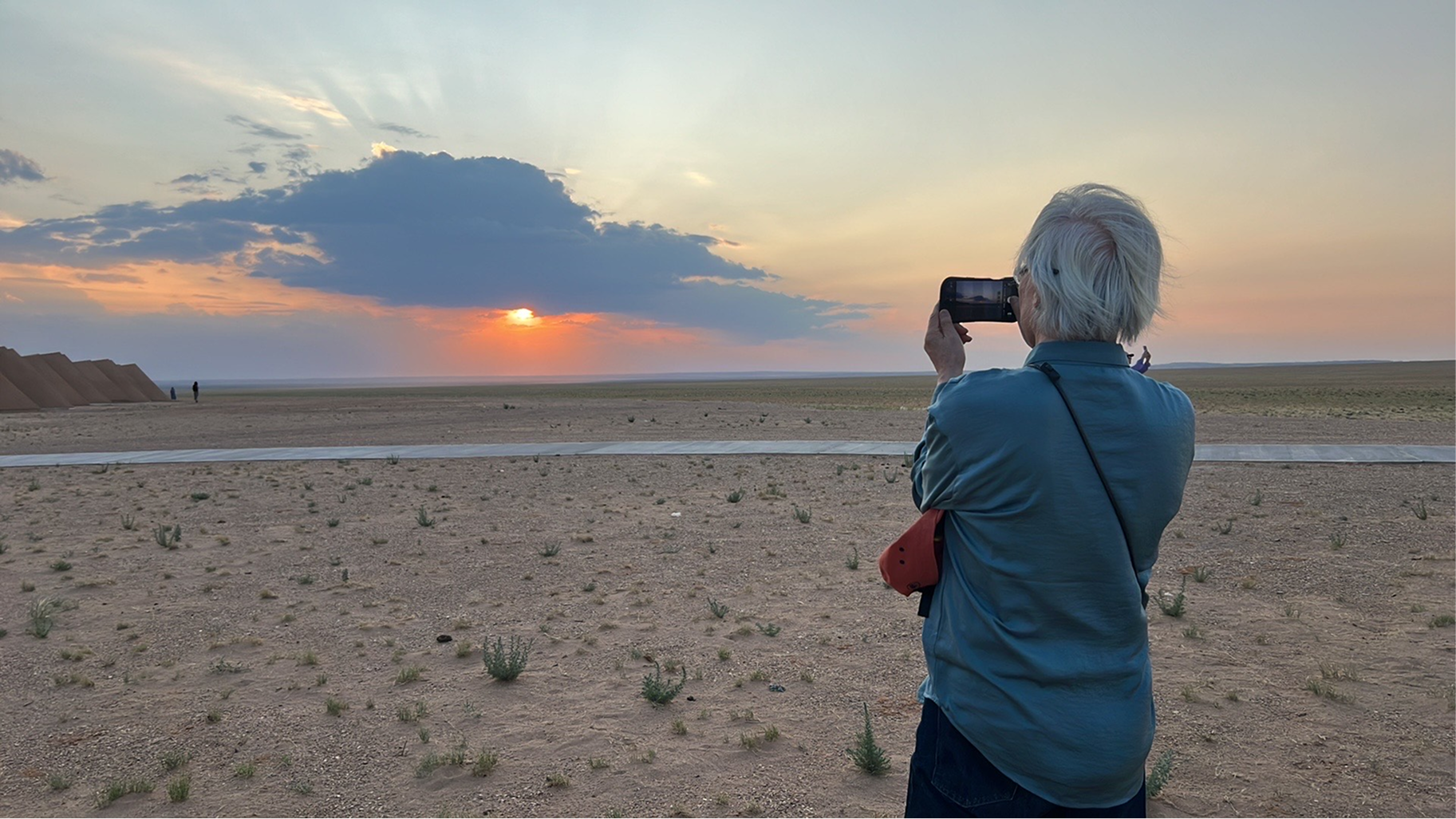
Soon after the shamanic ritual, Kuranuki traveled to the Gobi Desert. As he drove south from Ulaanbaatar, an immense landscape unfolded—ruled by wind and light alone. Scorching sun by day, a breath-stopping canopy of stars by night: the Gobi holds a strange silence in which “nothingness” and “everything” seem to coexist.
There, Kuranuki walked as if conversing with countless stones. Each stone had a face; each silence carried an echo. He eventually stopped before a single black stone—polished by wind over long time, as though it were trying to speak. It struck something deep within him.
“These stones are not simply material. They are the wind that has lived here.”
He lifted the stone in the fading light and offered milk and liquor to the sand. The Gobi wind wrapped the prayer and carried it toward the far horizon. In a profound sense, his Mongolian creation began at that moment.
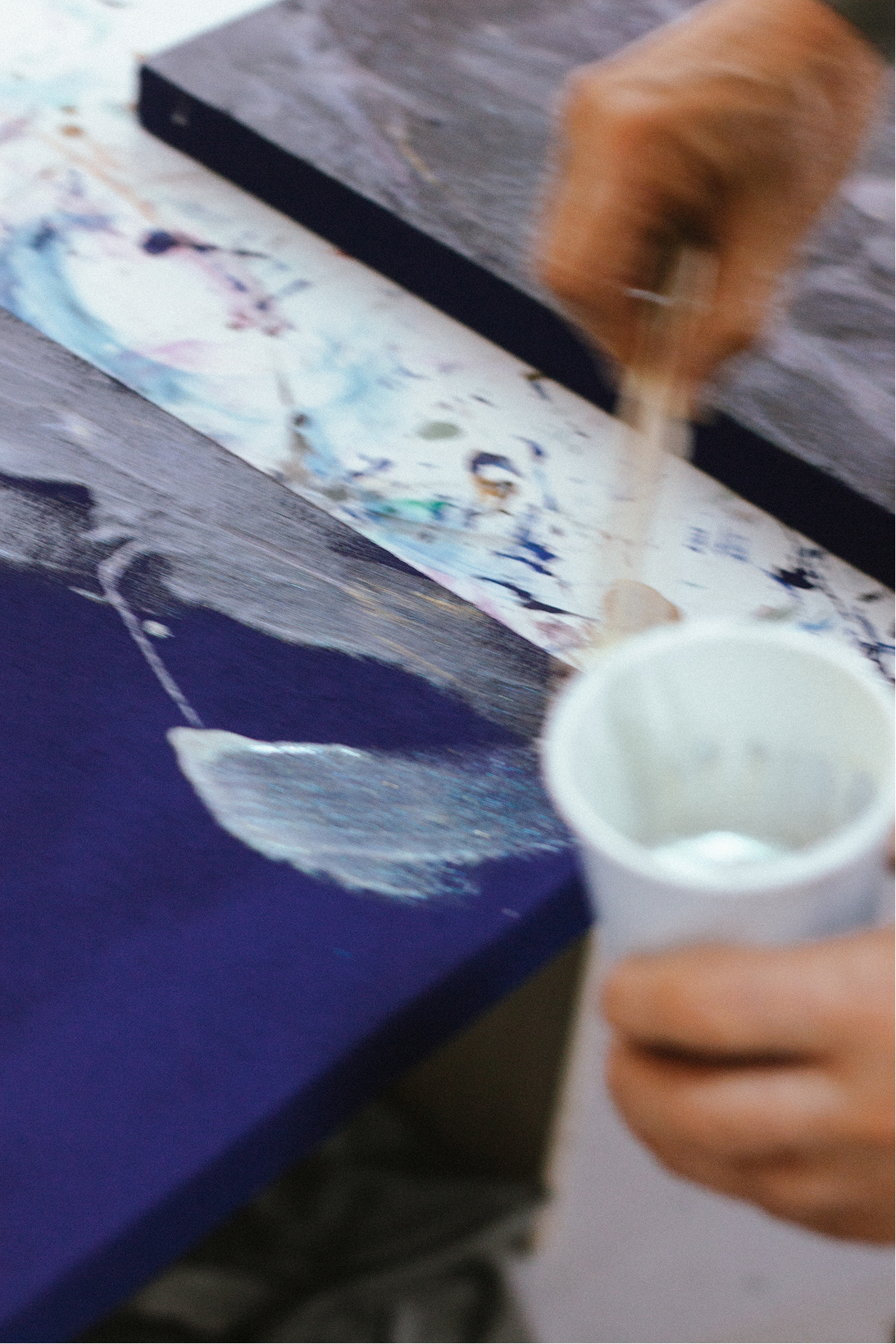
For the past seven years, Kuranuki has developed a distinctive process: he builds a painted surface using pigments and epoxy resin, layers acrylic paint on top, and then traces across the surface with stone.
For more than fifty years—since his teenage years—he has held to a conviction: to pursue an art that no one has attempted before. His experiments have included recording flames as photographic works by spreading gasoline over a pond; “erasing a photograph with a photograph” by printing new images over existing photographic scenes; and installations that present natural stones themselves as artworks.
Yet he also confronted a dilemma: however new an expression may be, time can quickly render novelty obsolete. He therefore asked himself a fundamental question:
“What was humanity’s oldest form of expression?”
Perhaps early humans picked up stones from the ground and drew vertical lines, horizontal lines, and circles. If the oldest method of expression could be transformed into something wholly original, then no “newness” could surpass it. Thus he resolved to draw with stone—the oldest material on Earth, and one that never becomes outdated. This idea became the origin of his current practice.
In Mongolia, the colors of the sky, the temperature of the wind, and memories carried from distant ancestors seem to breathe within the work. Reading these forces, Kuranuki layers surfaces, calculates refractions of light, and paints a quiet cosmos.

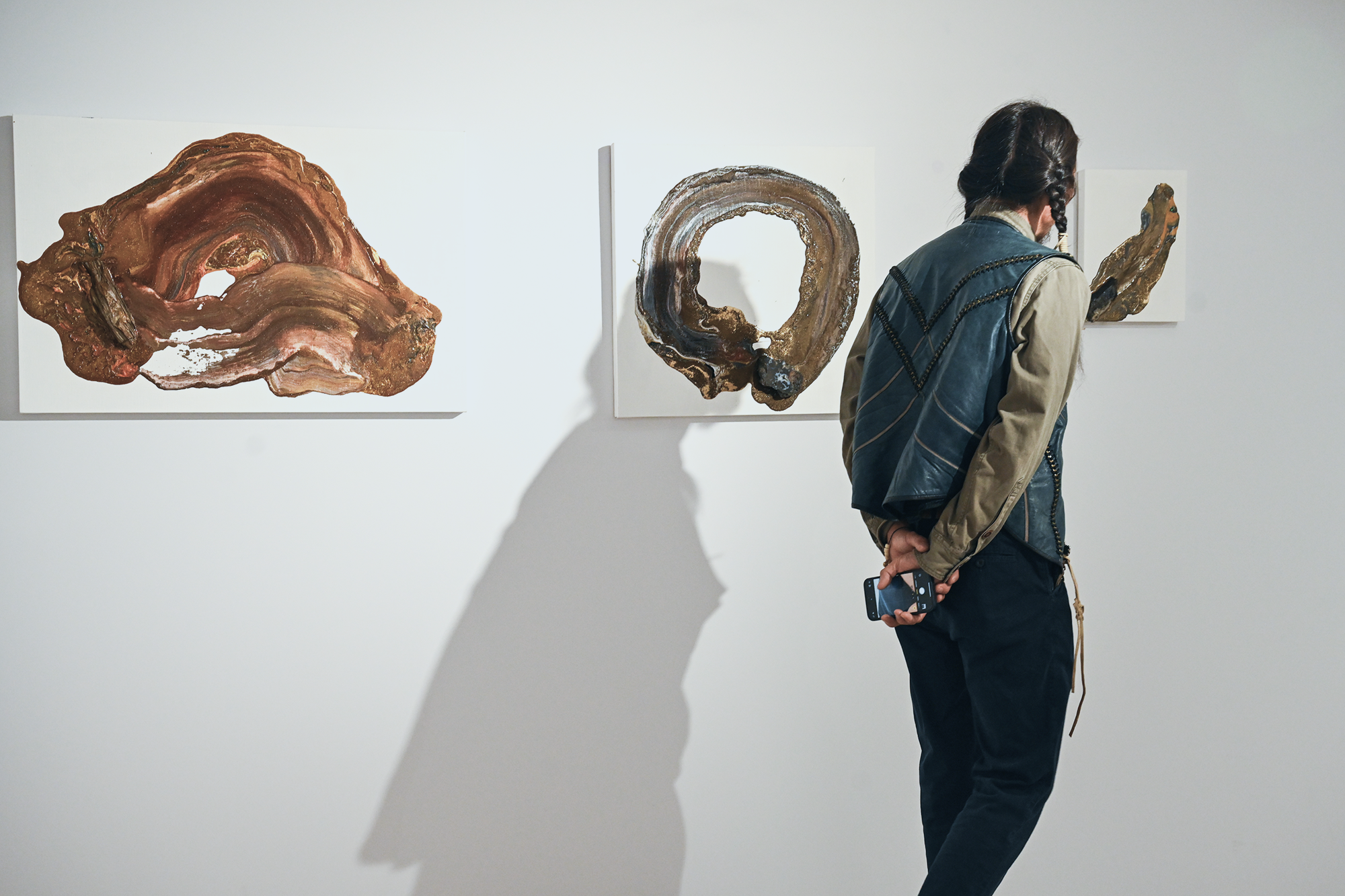
The origin and formation of stone—and the qualities and historical memories it contains—cannot be confined to the domain of science alone. They form part of humanity’s spiritual heritage, resonating through time in culture, belief, and aesthetics.
Meanings assigned to stone differ across civilizations: prayer, protection, memory, regeneration. In this sense, the relationship between stone and human beings has always been a dialogue at the deepest intersection of culture, aesthetics, belief, and memory.
Toru Kuranuki is the artist who revives that dialogue for the present. He regards stone not as a mere material, but as a being with intention. Over many years, he has observed and contemplated the relationships between humanity and nature, the world and time. For Kuranuki, nature is “the most perfect creator,” and the artist’s essential pursuit is to discover beauty within it.
His creative philosophy—Kyōzon-ha—centers on observing, conversing, understanding, and accepting difference. Within his works, the Earth seems to be dismantled and reconstituted, enabling viewers to read traces of origin, environment, and the marks of sun, wind, water, and snow. Kuranuki carefully studies each stone’s structure and color and fuses these observations into composition and the refraction of light.
“Stone is the oldest existence in the world, and it never becomes obsolete,” he says. This conviction lies at the core of Kyōzon-ha and suggests how deeply stone has shaped human evolution, daily life, social structures, civilization, and even science. His exhibitions do not merely depict the human–nature relationship; they reveal a world where heaven and earth, sea and land, faith and spirit melt into a single continuum—allowing us to experience the moment when the Earth’s memory speaks through stone.
Curator D. Tumursukh
S. Chuluun, Director of the Chinggis Khaan National Museum, noted that his own name refers to “stone,” and remarked that it was deeply moving to present, within a national history museum, the blessings of the land left by Chinggis Khaan as art.
Ch. Undaram, Mongolia’s Minister of Culture, observed that her name carries the meaning of “gold-bearing crystal,” and expressed joy at seeing colors in Kuranuki’s works that recalled “the stone of her name,” offering gratitude and a warm welcome for his contribution to new directions in Mongolian art.
L. Dashnyam, Presidential Advisor on Language Policy—widely known as a “poet who writes stone,” having produced more than thirty poems and aphorisms on the theme—praised Kuranuki for giving visual form to what stone’s colors and memories speak to the human heart, and expressed admiration for the Japanese sensibility of elevating the small and everyday into art and value.
Kuranuki and Dashnyam are currently preparing a collaborative poetry-and-art volume, scheduled for release in January 2026.
The artwork (K25174 / 117 cm × 91 cm) was created by Toru Kuranuki using Mount Fuji lava stone—his most revered and symbolically significant material—brought from Japan.
For Kuranuki, this work is an offering of the spirituality and power of Mount Fuji, cherished deeply by the Japanese people, to the open-hearted spirit and rich cultural traditions of the people of Mongolia. It is intended as a gift that symbolizes the spiritual bond between Japan and Mongolia.
As a sign of friendship between our two nations, and with heartfelt prayers for Mongolia’s future development and for the enduring amity between Mongolia and Japan, this work has been created and presented with profound respect.
Editor: Ariunjargal.A (Project Manager)
.jpg)