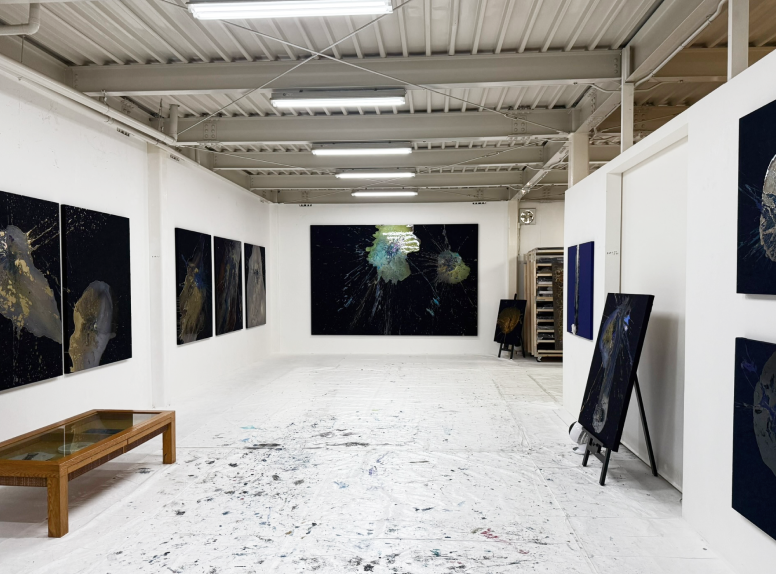
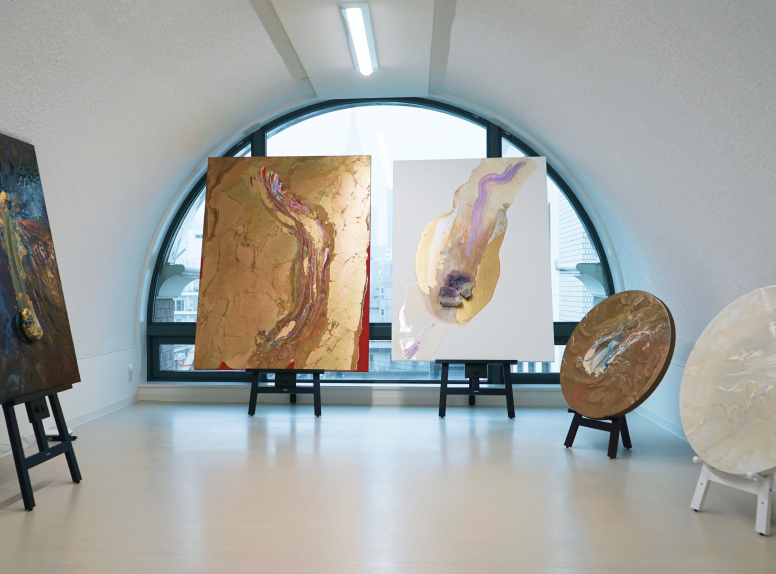
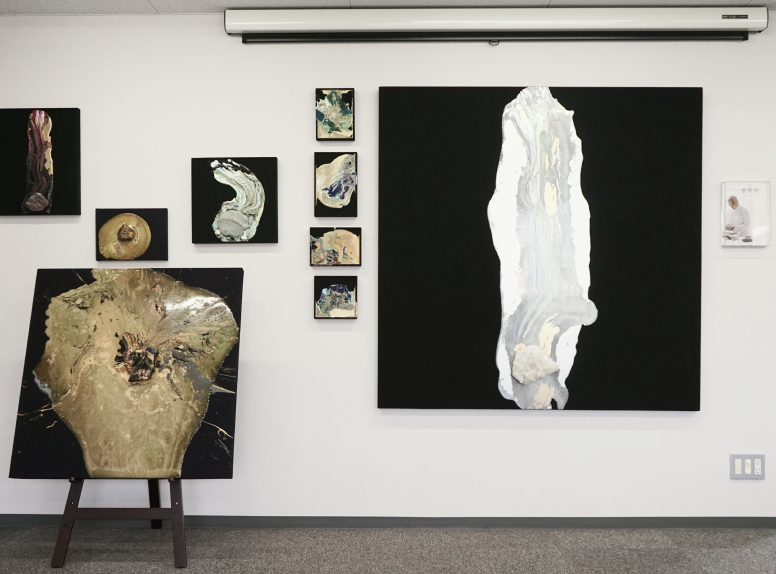
Kuranuki Toru first drew attention for his radical, avant-garde practice when he was invited to the “’69 Gutai New Artists Exhibition” at Gutai Pinacotheca (Osaka) in 1969. The following year, in the large-scale exhibition “Trends in Contemporary Art” (1970), he left a lasting impression on the art world through works that pushed the boundaries of the medium—most notably a performance in which he used fire to burn a work, and experimental pieces incorporating fossils and minerals as material.
Kuranuki is also known for his deep and sustained exchange with Kazuo Shiraga, one of the leading figures of the Gutai movement. In 1989, at Gallery KURANUKI (Osaka)—which he founded and directed—Kuranuki curated and presented a solo exhibition of Shiraga’s work. In 1990, he authored and published the exhibition catalogue Kazuo Shiraga and Buddhist Art, documenting and expanding upon the intellectual outcomes of that project. Through these initiatives, Kuranuki’s role extends beyond that of an artist: he has also realized a meaningful form of creative collaboration with Shiraga as a curator and publisher.
In recent years, Kuranuki’s early works have been re-evaluated and newly spotlighted, notably in “Re: Start Line 1963–1970” (2023) at the National Museum of Modern Art, Kyoto. Across decades of experimentation, his artistic inquiry continues to deepen—shaped, in particular, by the generative relationship he cultivated with Kazuo Shiraga.
January 2026 (Part 3) — “Toru Kuranuki: Painting with Stone, Resonating with Stone”
At the venue of Kuranuki’s new exhibition in Ulaanbaatar, Yuichi Takami and Kazumi Arikawa—both closely connected to the artist—joined him in a conversation exploring the world of Kyōzon.
December 2025 (Part 2) — “Toru Kuranuki: Painting with Stone, Resonating with Stone”
The new exhibition at the Chinggis Khaan National Museum and the “ancient yet new” world of Kyōzon, in resonance with the Mongolian land.
November 2025 (Part 1) — “Toru Kuranuki: Painting with Stone, Resonating with Stone”
Kuranuki’s singular methods and his depiction of harmony between humanity and the Earth—introducing the philosophy he advocates, Kyōzon-ism.